22
Sep
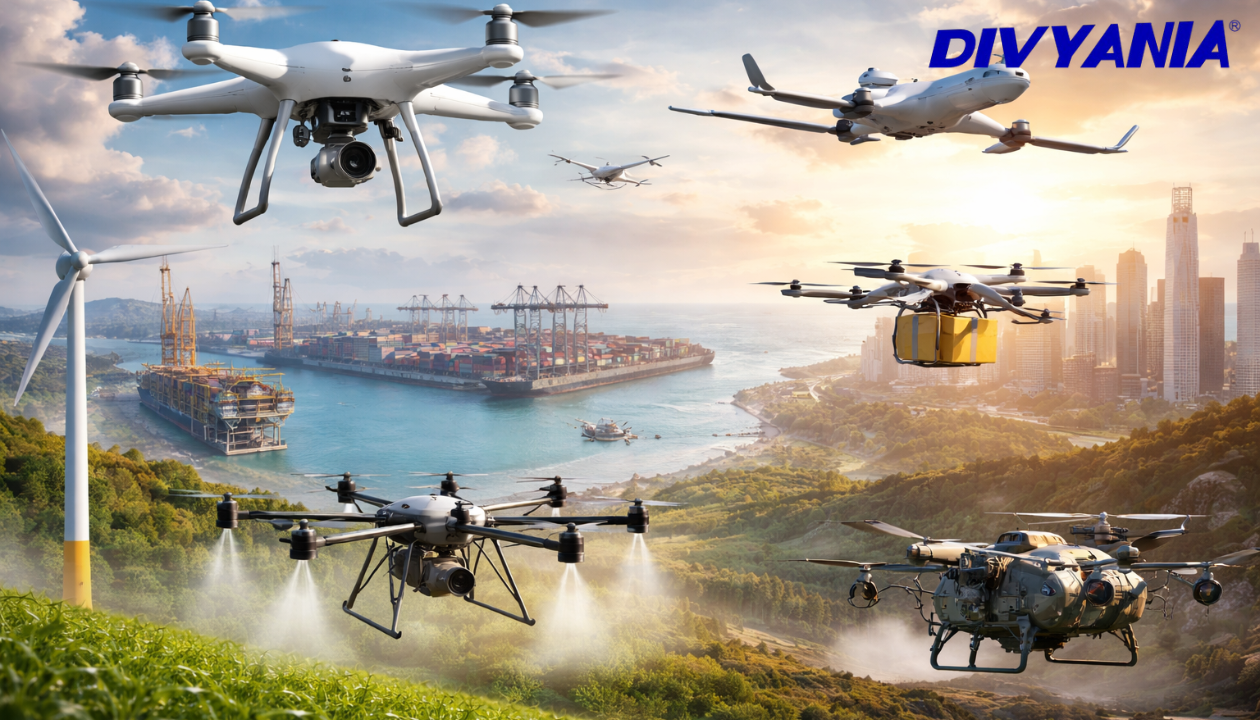
In recent years, Unmanned Aerial Vehicles (UAVs) — commonly known as drones — have transformed from niche military tools into versatile, multi-industry assets. From defence operations and agriculture to infrastructure inspection and logistics, UAVs are redefining efficiency, intelligence, and safety in modern operations.
According to Fortune Business Insights (2024), the global UAV market was valued at USD 30.6 billion in 2024 and is projected to reach USD 68.8 billion by 2032, growing at a CAGR of 10.6%. This explosive growth signals a new era of aerial intelligence and automation — one that Divyania INC is deeply invested in, offering advanced UAV solutions for defence, industrial, and agricultural applications.
A UAV (Unmanned Aerial Vehicle) is an aircraft operated without a human pilot onboard. It can be remotely controlled or fly autonomously using pre-programmed routes, GPS, and AI-powered systems.
UAVs provide cost-effective, high-precision, and data-driven capabilities that make them invaluable for:
With continuous advancements in AI, energy systems, and miniaturized sensors, UAVs now serve as intelligent aerial partners across multiple industries — helping organizations make faster, safer, and smarter decisions.
UAVs vary widely depending on their size, range, purpose, and control system. Here’s a breakdown:
2.1 Based on Size and Range
|
Type |
Typical Range |
Key Use Case |
|
Nano / Micro UAVs |
<5 km |
Law enforcement, indoor inspection |
|
Mini UAVs |
5–50 km |
Agriculture, photography, mapping |
|
Tactical UAVs |
50–200 km |
Military reconnaissance, border patrol |
|
MALE (Medium Altitude Long Endurance) |
200–1000 km |
Strategic defence, surveillance |
|
HALE (High Altitude Long Endurance) |
>1000 km |
Atmospheric research, communication relays |
(Source: NATO UAV Classification Standards)
2.2 Based on Control System
2.3 Based on Platform Type
3.1 Defence and Security
The defence sector remains the largest UAV consumer, accounting for over 52% of global UAV spending in 2024
(Source: Stratview Research, 2024).
Key applications include:
Divyania INC’s DIA 17 Pro and DIA 19 Pro UAVs are designed with thermal cameras and AI-assisted gimbal stabilization, offering defence-grade precision and stability in demanding conditions.
3.2 Agriculture and Environmental Monitoring
Drones have revolutionized modern farming by enabling precision agriculture — helping farmers monitor crop health, manage irrigation, and optimize pesticide use.
Key insights:
Divyania’s agricultural UAVs are built for durability, large-area coverage, and customizable sensor integrations, supporting sustainable farming and environmental monitoring.
3.3 Industrial Inspection and Energy Sector
In sectors like oil, gas, and renewable energy, UAVs have replaced risky manual inspections.
Deloitte Insights (2024) reports that drone-assisted inspections are 40% faster and 25% more cost-efficient compared to traditional methods.
Applications include:
When integrated with Divyania Energy Storage Systems (ESS), UAVs can operate longer and transmit data continuously even in remote conditions — optimizing uptime and reducing operational costs.
3.4 Smart Cities and Logistics
The role of UAVs in urban management and smart city infrastructure is rapidly expanding.
According to PwC Drone Report (2024), the global cargo and delivery UAV market is projected to reach USD 12.5 billion by 2030.
Applications include:
These applications reduce human dependency and enhance urban efficiency.
3.5 Filmmaking, Mapping, and Surveying
High-resolution imaging UAVs are now the industry standard in filmmaking, media, and topographical mapping.
Divyania’s DIA 10 Pro Thermal Imaging Edition, featuring a 4096×3072P photo resolution, 3-axis brushless gimbal, and thermal sensor integration, is ideal for:
These UAVs bring precision, stability, and visual clarity even under challenging environments.
4.1 AI and Autonomous Operations
Artificial Intelligence (AI) is redefining UAV autonomy. With features like real-time object detection, predictive pathfinding, and swarm intelligence, UAVs are evolving into self-reliant aerial systems.
Tier Content for Future Blog:
“AI in UAVs: How Autonomy is Reshaping Military and Civil Applications”
4.2 IoT and Cloud Integration
The combination of UAVs with IoT (Internet of Things) and cloud analytics enables real-time data visualization and predictive maintenance.
For industries like energy and manufacturing, this means smarter monitoring and faster decision-making.
Tier Content for Future Blog:
“IoT-Driven UAV Networks for Industrial Data Collection”
4.3 Sustainability and Hybrid Power Systems
With increasing environmental awareness, manufacturers are focusing on energy-efficient and sustainable UAVs.
Tier Content for Future Blog:
“The Future of Hybrid UAV Power Systems”
4.4 Regulatory Developments
As UAV adoption grows, so does the need for robust regulations.
The Directorate General of Civil Aviation (DGCA) in India has reported a 37% increase in UAV registrations in 2024, reflecting rising commercial and industrial use.
(Source: DGCA Annual Report, 2024)
Key frameworks include:
Tier Content for Future Blog:
“Navigating UAV Regulations for Industrial Deployment in India”
Despite rapid advancement, several challenges persist:
However, these challenges are opportunities for innovation — and companies like Divyania INC are leading the charge by combining UAV expertise, AI-driven systems, and next-generation energy storage to redefine aerial operations.
UAVs have evolved from simple flying cameras to autonomous, intelligent aerial systems that are reshaping industries. Their growing adoption across defence, agriculture, energy, logistics, and cinematography highlights their unmatched versatility.
At Divyania INC, we envision a future where technology, intelligence, and sustainability converge.
Our UAV series — DIA 10 Pro, DIA 17 Pro, and DIA 19 Pro — are designed for precision, endurance, and reliability, empowering industries to operate smarter and safer from above.
References
Reach Us