22
Sep
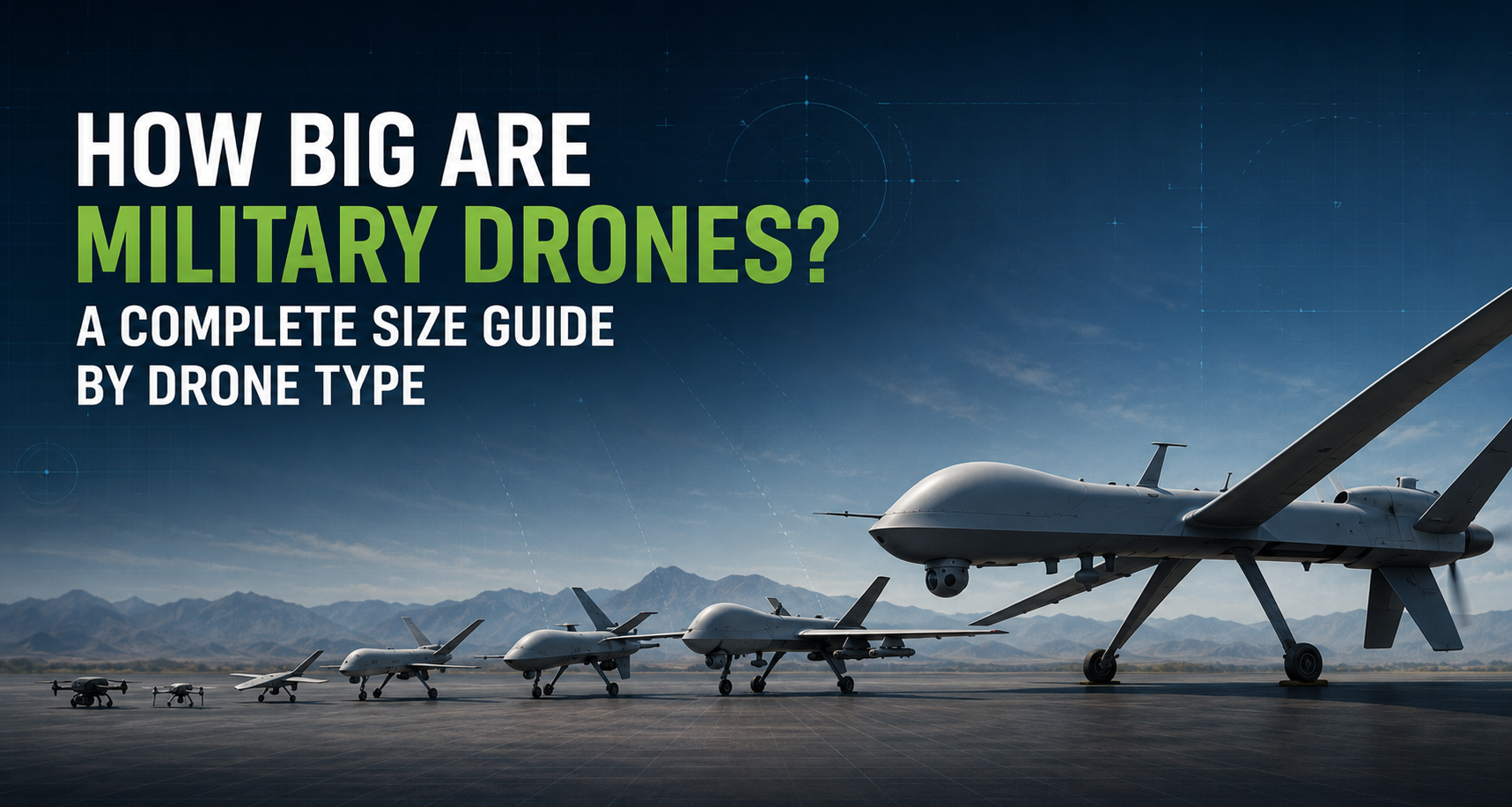
Military drones have transformed modern warfare by providing armed forces with advanced intelligence, surveillance, reconnaissance (ISR), and precision strike capabilities. However, one of the most common questions among defense professionals, procurement officers, and military enthusiasts is: How big are military drones?
For defense organizations and procurement agencies, understanding how big military drones are is more than a technical question it directly influences mission planning, payload capacity, endurance, operational range, and deployment strategies. Different military drone sizes are designed to fulfill specific operational requirements, whether supporting border surveillance, maritime security, electronic warfare, or combat operations.
The answer isn't straightforward because military drones range from palm-sized reconnaissance systems that fit inside a soldier's pocket to aircraft-sized unmanned aerial vehicles (UAVs) capable of flying thousands of kilometers. Their size depends on their mission, payload requirements, endurance, and operational environment.
This guide explores the different size categories of military drones, explains why size matters, and highlights how drone dimensions influence military operations.
Unlike commercial drones, military UAVs are purpose-built for specific missions. Size directly impacts a drone's performance, including:
In military operations, selecting the right drone size is a strategic decision rather than simply choosing the largest platform available.
Military drones are generally classified into several categories based on their dimensions and operational roles.
|
Drone Category |
Approximate Size |
Primary Mission |
|
Nano & Micro UAVs |
10–30 cm |
Close-range reconnaissance |
|
Small Tactical UAVs |
30 cm–2 m |
ISR, artillery spotting |
|
Medium Tactical UAVs |
2–6 m wingspan |
Border surveillance, intelligence |
|
MALE Combat Drones |
10–20 m wingspan |
Long-range surveillance and strike |
|
HALE Strategic UAVs |
30–40+ m wingspan |
Strategic intelligence gathering |
Each category serves a distinct purpose on today's battlefield.
Small military drones are designed to support soldiers operating close to the frontline. These UAVs typically weigh only a few hundred grams to several kilograms and are compact enough to be carried in a backpack.
Nano drones are approximately the size of a human hand and are primarily used for indoor reconnaissance, urban operations, and short-range surveillance.
Slightly larger quadcopters and First-Person View (FPV) drones have become increasingly important in modern conflicts. Their ability to conduct reconnaissance, identify enemy positions, adjust artillery fire, and deliver small explosive payloads has significantly expanded their battlefield role.
Because of their small radar signature and low operating cost, these drones are difficult to detect and can be deployed rapidly in large numbers.
Medium-sized UAVs bridge the gap between portable drones and strategic combat aircraft. These systems typically feature wingspans ranging from two to six meters and are capable of remaining airborne for several hours.
These drones perform missions such as:
Many tactical UAVs use fixed-wing designs, allowing them to cover greater distances while consuming less energy than rotary-wing drones.
Another growing category is the Vertical Take-Off and Landing (VTOL) military drone. These aircraft combine helicopter-like vertical takeoff with the efficiency of fixed-wing flight. VTOL drones eliminate the need for runways, making them ideal for naval vessels, remote bases, and rapidly changing operational environments.
When most people imagine military drones, they think of large combat UAVs like the MQ-9 Reaper or Bayraktar TB2. These platforms belong to the Medium Altitude Long Endurance (MALE) category.
Combat drones typically feature wingspans between 10 and 20 meters comparable to small manned aircraft.
Their larger size enables them to carry:
These drones can remain airborne for more than 24 hours while continuously monitoring large areas and conducting precision strikes when required.
The additional space inside larger airframes also supports redundant flight systems and advanced avionics, improving mission reliability during long-duration operations.
At the top end of the size spectrum are High Altitude Long Endurance (HALE) drones.
These aircraft are among the largest unmanned systems in military service, with wingspans exceeding 35 meters in some cases similar to commercial passenger aircraft.
Strategic UAVs are designed for missions such as:
Operating at altitudes above 60,000 feet, HALE drones can survey vast regions while remaining outside the range of many conventional air defense systems.
Their enormous wings provide exceptional lift and fuel efficiency, allowing missions lasting well over 30 hours.
Modern defense requirements continue to drive the development of larger UAVs.
Today's military drones increasingly carry advanced technologies, including:
These capabilities require additional internal space, electrical power, and cooling systems, all of which contribute to larger airframe designs.
As autonomous military drone technology advances, onboard computing hardware and sophisticated navigation systems are expected to further influence UAV size and design.
While larger drones dominate long-range surveillance and strike missions, recent conflicts have demonstrated the critical value of smaller UAVs.
Compact drones offer several tactical advantages:
FPV drones have emerged as one of the most disruptive technologies in modern warfare, providing affordable precision strike capabilities against armored vehicles, fortifications, and personnel.
Military planners increasingly recognize that future operations will require a combination of both large strategic UAVs and numerous small tactical drones working together.
Drone size also determines how easily a UAV can be detected and neutralized.
Large combat drones generally produce stronger radar, infrared, and acoustic signatures, making them easier to identify at long distances. However, they often incorporate advanced electronic countermeasures and defensive systems.
Conversely, small quadcopters and nano drones present significant challenges for traditional air defense networks due to their minimal radar cross-section and low-altitude flight profiles.
Modern anti-drone systems therefore employ a layered approach using radar, radio frequency detection, electro-optical sensors, thermal imaging, and electronic jamming to counter threats across multiple drone size categories.
There is no standard size for military drones because every UAV is engineered around its intended mission. Some drones are small enough to fit inside a soldier's hand, while others rival conventional aircraft in size and endurance.
Small tactical drones excel at close-range reconnaissance, urban warfare, and rapid deployment. Medium UAVs provide reliable intelligence collection and battlefield support, while large combat drones deliver long-endurance surveillance and precision strike capabilities. Strategic HALE drones extend military reach even further by conducting persistent intelligence operations across vast geographic regions.
At Divyania, we understand that selecting the right defense technologies requires accurate information and industry expertise. As a trusted defense equipment company, Divyania is dedicated to delivering valuable insights into military drones, combat drones, autonomous military drone technologies, and anti-drone systems, helping defense professionals and government agencies make informed decisions in an increasingly technology-driven security environment.
Reach Us