22
Sep
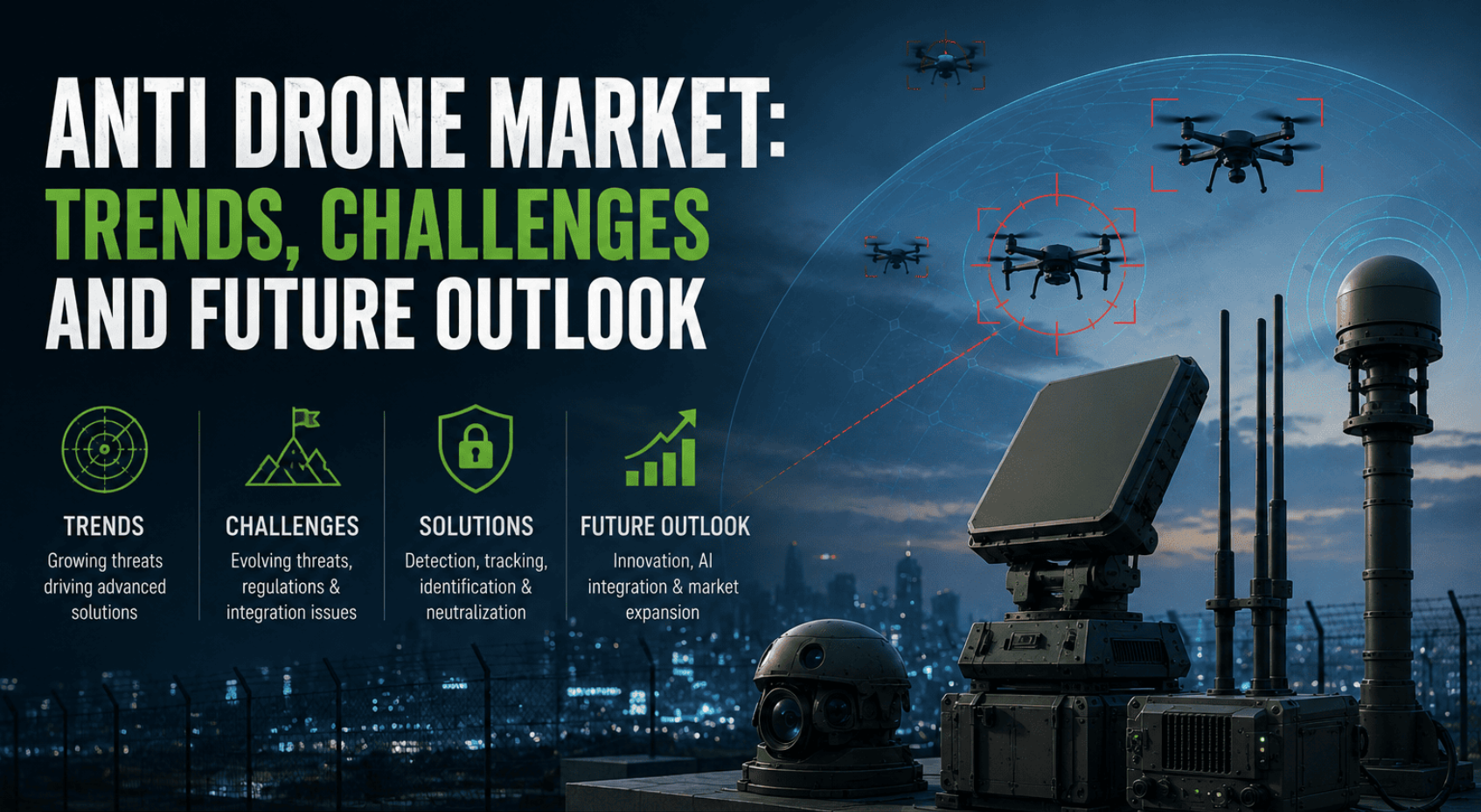
The rapid growth of unmanned aerial vehicles has created significant opportunities across defense, logistics, agriculture, surveillance, infrastructure, and commercial applications. However, the increasing accessibility of drones has also introduced new security concerns. Unauthorized drones can enter restricted airspace, monitor sensitive locations, disrupt airport operations, or create risks around critical infrastructure.
As these threats evolve, demand for advanced anti drone system technologies is increasing across military, government, aviation, and commercial security sectors. Modern solutions are moving beyond basic detection and increasingly combine radar, radio-frequency sensors, electro-optical cameras, thermal imaging, artificial intelligence, and command-and-control platforms.
The global anti-drone market is experiencing strong growth as organizations invest in technologies capable of detecting, identifying, tracking, and responding to unauthorized aerial activity.
The anti-drone market includes technologies and services designed to protect airspace from unauthorized or potentially threatening unmanned aircraft. The industry covers detection systems, tracking technologies, identification platforms, mitigation solutions, software, sensors, and integrated security architectures.
Market demand is no longer limited to traditional defense applications. Airports, energy facilities, government buildings, prisons, public venues, and other critical infrastructure operators are also exploring counter-drone capabilities.
This expansion is creating opportunities for manufacturers and technology providers to develop systems that can operate across different environments while remaining scalable and adaptable.
One of the biggest trends is the shift from standalone detection equipment toward integrated counter drone system architectures.
Modern platforms increasingly combine radar, RF detection, electro-optical and infrared sensors, AI analytics, tracking software, and command-and-control capabilities. This allows multiple sources of information to be processed together and provides operators with a more complete understanding of aerial activity.
The move toward layered systems is being driven by increasingly fast, small, autonomous, and coordinated drone threats that can be difficult to manage with a single technology.
Artificial intelligence is becoming an important part of anti drone technology. AI-powered systems can analyze large amounts of sensor information and help classify aerial objects more efficiently.
Advanced analytics can assist in distinguishing drones from birds, aircraft, and other objects, potentially reducing false alarms. AI can also support automated tracking and faster threat assessment.
As the number and complexity of aerial objects increase, intelligent data processing is expected to become increasingly important for security operators.
The market is expanding into civilian and commercial environments. Airports, oil and gas facilities, power infrastructure, ports, stadiums, and other sensitive locations are increasingly considering counter-UAS capabilities.
This expansion is encouraging the development of more flexible and scalable systems that can be adapted to different security requirements.
Another important trend is the growing use of multiple sensors within a single security architecture.
Radar can provide initial detection, RF sensors can identify communication activity, and electro-optical or thermal cameras can help verify an aerial object. Combining these technologies can provide stronger situational awareness than relying on one sensor alone.
Despite strong growth, the industry faces several technical, regulatory, and commercial challenges.
Small drones can be difficult to detect because of their size, low-altitude flight patterns, and limited observable signatures. Autonomous or low-RF drones can also reduce the effectiveness of systems that depend heavily on communication signals.
Urban environments create additional difficulties because buildings, power infrastructure, birds, weather, and electromagnetic interference can produce false detections or complicate tracking.
Regulation remains one of the most significant challenges for the industry. Technologies involving RF interference, signal disruption, or other mitigation methods may be subject to strict national laws and aviation regulations.
Different countries have different rules regarding who can detect, track, interfere with, or neutralize unauthorized drones. This lack of uniformity can make deployment more complicated for both manufacturers and end users.
Advanced counter-UAS infrastructure can require multiple sensors, software platforms, communication networks, trained operators, and ongoing technical support.
For smaller organizations, the cost of deploying and maintaining a complete system can be a significant barrier. This is increasing demand for modular systems that allow customers to begin with essential capabilities and expand their infrastructure over time.
Drone technology is advancing quickly. New aircraft can feature improved autonomy, encrypted communications, smaller designs, and coordinated operating capabilities.
As a result, counter-UAS technologies must continuously evolve to remain effective. Manufacturers need to update software, improve sensors, and develop new detection and classification capabilities as drone designs change.
The future of the market is expected to be shaped by greater automation, AI-assisted detection, sensor fusion, and networked security systems.
Future platforms are likely to move further toward integrated architectures where radar, RF monitoring, optical sensors, thermal imaging, analytics, and command-and-control systems operate together.
Another important development will be scalability. Customers will increasingly look for systems that can protect different types of locations without requiring a complete redesign of their security infrastructure.
The market is also expected to expand across airports, critical infrastructure, public safety, military facilities, borders, and commercial environments. Current industry forecasts point to substantial growth through the next decade, although estimates vary significantly between research firms.
As unauthorized drone activity becomes an increasing security concern, organizations require technologies capable of providing reliable detection, tracking, and threat assessment. Divyania offers integrated anti drone solutions that combine technologies such as RF spectrum monitoring, 3D radar tracking, electro-optical sensing, and AI-powered analytics.
Its systems are designed for applications including defense operations, border security, critical infrastructure, strategic assets, and other high-security environments. By bringing multiple detection and monitoring capabilities together, these solutions support a layered approach to modern aerial security.
The anti-drone market is transitioning from a specialized defense segment into a broader component of modern airspace security. Growing drone adoption, evolving aerial threats, and increasing protection requirements for critical infrastructure are driving demand for more advanced technologies.
AI-powered analytics, multi-sensor architectures, integrated command platforms, and scalable security solutions are expected to shape the industry's next phase. At the same time, regulatory restrictions, high deployment costs, false detections, and rapidly evolving drone technologies will remain important challenges.
Organizations looking to invest in an anti drone defense system should therefore focus on solutions that can adapt to changing threats, integrate multiple technologies, and support long-term security requirements. As the drone ecosystem continues to evolve, intelligent and layered counter-UAS technologies will become increasingly important for protecting sensitive airspace and critical assets.
Reach Us