22
Sep
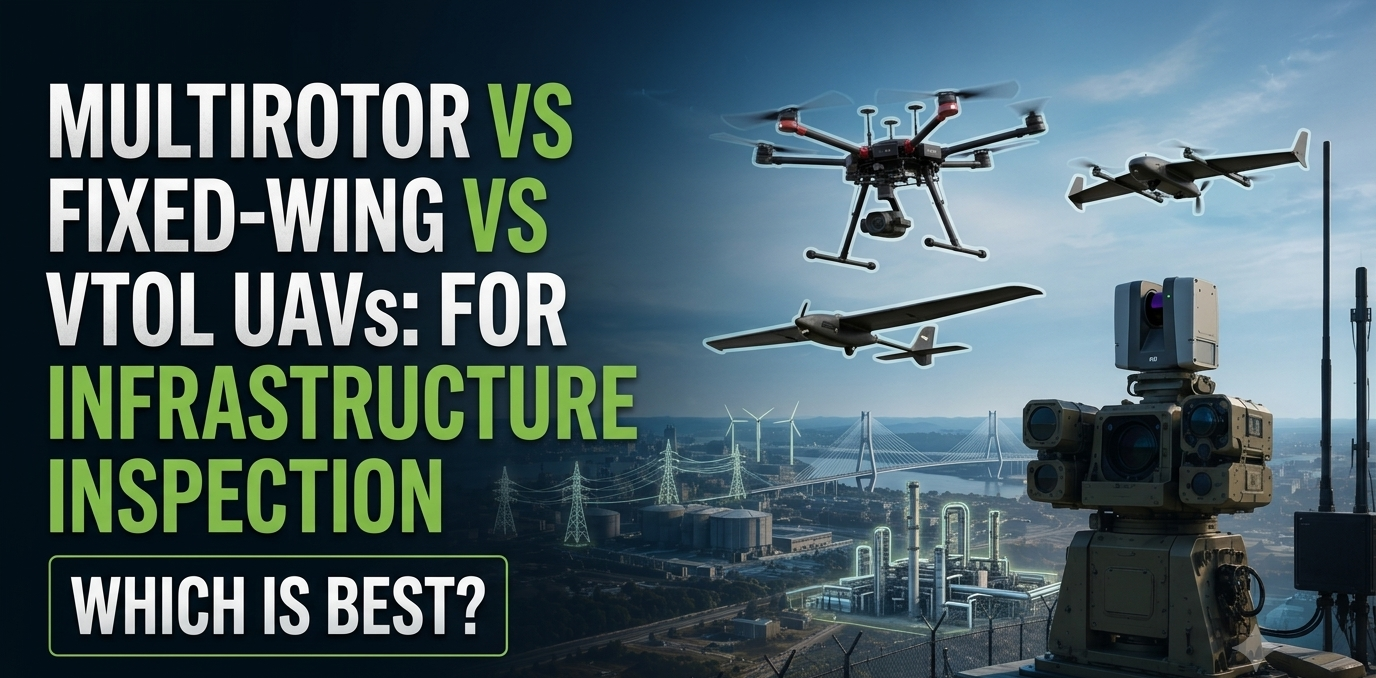
Power companies inspect transmission lines, distribution feeders, substations, pipelines, and renewable energy sites that are spread across long distances and varied terrain. Drones have become a practical way to collect inspection data, but not every unmanned aircraft suits every job. The three main platform types, multirotor, fixed-wing, and VTOL, each offer different strengths and trade-offs.
Choosing the wrong platform can mean short flights when long corridors need to be covered, or poor image detail when close-up checks are required. This guide compares the three platform types and explains how operators can decide which one fits their inspection needs.
There is no single best platform.
Many power companies end up using more than one type.
Multirotor UAVs use several rotors to lift and maneuver. They can take off vertically, hover in place, and fly slowly around assets.
Fixed-wing UAVs use wings to generate lift, like a conventional aircraft. This makes them efficient in flight, but they usually need space to launch and land and cannot hover.
VTOL (vertical take-off and landing) UAVs are hybrids. They lift off and land using rotors, then transition to wing-borne flight for efficient cruising.
Before comparing them, operators should define what they need to inspect, how far the aircraft must travel, and what data they need to collect.
Multirotors are the most widely used platform for asset-level inspection. Their ability to hover and fly slowly makes them well suited to examining towers, poles, insulators, and substation equipment from multiple angles.
Strengths:
Limitations: Shorter flight time and limited range make them less efficient for covering very long lines.
Fixed-wing aircraft are more energy-efficient in forward flight, so they can stay airborne longer and cover more ground per flight. This makes them a strong fit for long transmission corridors, pipeline routes, and large right-of-way surveys.
The long-endurance design is familiar from military surveillance drones, which are built to observe wide areas for extended periods. Grid operators benefit from the same principle when they need consistent coverage along many kilometers of infrastructure.
Limitations: They need launch and landing space, cannot hover, and are less suited to detailed close-up checks of individual components.
VTOL platforms aim to solve the main weakness of fixed-wing aircraft by removing the need for a runway or launch rail. They can take off from tight or rugged locations, then cruise efficiently over long distances.
Long-endurance and vertical-launch concepts have been widely explored in defense programs, and a military UAV heritage is visible in many hybrid designs. For power companies, this can translate into useful range in remote or forested terrain where launching a conventional fixed-wing aircraft is difficult.
Trade-offs: Higher cost, more mechanical complexity, added weight from the lift system, and more demanding maintenance and training.
Flight endurance: Multirotors offer low to medium endurance. Fixed-wing aircraft offer high endurance. VTOL platforms fall in between, at medium to high.
Operational range: Multirotors cover short to medium distances. Fixed-wing and VTOL aircraft both cover long distances.
Hovering: Multirotors can hover freely. Fixed-wing aircraft cannot hover at all. VTOL platforms hover only during take-off and landing.
Launch and landing space: Multirotors and VTOL platforms need minimal space. Fixed-wing aircraft need open ground or a launch system.
Close-up inspection: Multirotors are excellent. VTOL platforms are moderate. Fixed-wing aircraft are limited.
Corridor coverage: Fixed-wing aircraft are excellent. VTOL platforms are very good. Multirotors are limited.
Payload flexibility: Multirotors are good. Fixed-wing and VTOL platforms are moderate.
Cost and complexity: Multirotors are the most affordable and simple. Fixed-wing aircraft sit in the middle. VTOL platforms are the most expensive and complex.
Best suited for: Multirotors suit towers, poles, and substations. Fixed-wing aircraft suit long lines and pipelines. VTOL platforms suit remote long-range patrols.
The platform must be able to carry the sensors the mission requires. Common options include high-resolution cameras, thermal imaging systems, zoom cameras, LiDAR, and multi-sensor payloads.
Payload capacity, power availability, and stability all affect data quality. A platform with impressive flight time is not useful if it cannot carry the right sensor, so payload should be evaluated together with endurance.
Automated flight planning, repeatable routes, obstacle awareness, and return-to-base functions are increasingly common in commercial inspection platforms. Features once associated mainly with an autonomous military drone are now available in tools designed for infrastructure work.
Automation helps produce consistent data and reduces pilot workload, especially on long routes. Human oversight remains important, and skilled operators should stay in control of safety decisions.
Wind, temperature, rain, and terrain affect each platform differently. Lightweight multirotors can struggle in strong wind, while fixed-wing aircraft may be more stable in cruise but need suitable launch and recovery areas.
Regulations also matter. Long-range operations often depend on rules for flying beyond visual line of sight, so operators should confirm what is permitted in their region before choosing a platform for corridor work.
Purchase price is only part of the cost. Operators should also consider:
A lower-cost multirotor may be more economical for local inspections, while a more complex VTOL platform may deliver better value where range is essential.
For many power companies, the practical answer is a combination of platforms. Fixed-wing or VTOL aircraft can survey long corridors and identify areas of concern, while multirotors can follow up with detailed inspection where needed.
This approach uses each platform where it performs best and can reduce both inspection time and unnecessary site visits.
Choosing between multirotor, fixed-wing, and VTOL platforms depends on mission requirements, terrain, sensor needs, and long-term support. Divyania provides advanced UAV solutions designed for applications including infrastructure inspection, surveillance, monitoring, and threat detection.
Its platforms incorporate technologies such as AI-driven navigation, multi-sensor payloads, long-endurance capabilities, and advanced communication systems, helping operators match the right aerial platform to their inspection and maintenance needs across large power networks.
Multirotor, fixed-wing, and VTOL UAVs each have a clear role in infrastructure inspection. Multirotors excel at detailed, close-range checks. Fixed-wing aircraft cover long corridors efficiently. VTOL platforms offer flexibility for remote long-range work, with added cost and complexity.
The best choice is not the platform with the highest specifications, but the one that matches the inspection mission, terrain, payload needs, and budget. For many power companies, a mixed fleet provides the most practical and cost-effective results.
Reach Us