23
Oct
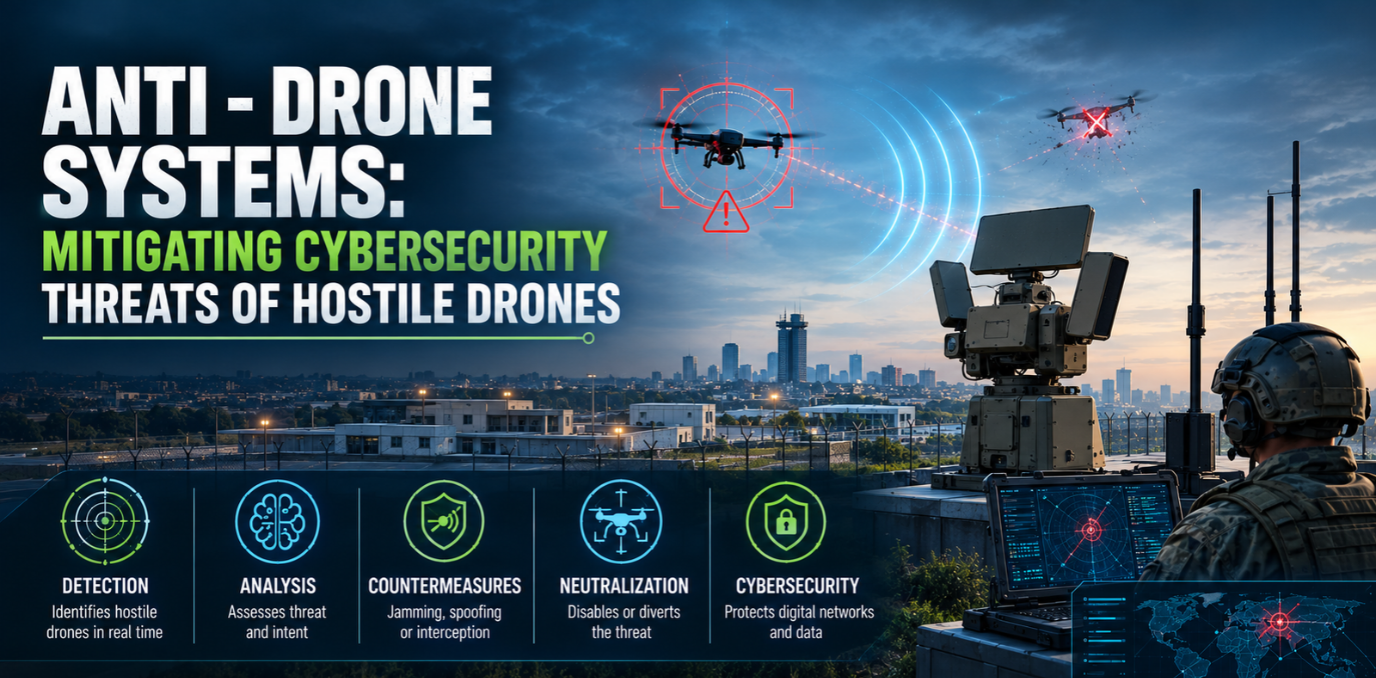
Drones have become important tools for surveillance, inspection, and defense operations. However, their growing availability has also introduced security challenges for military installations, airports, government buildings, and critical infrastructure. Hostile drones can conduct unauthorized surveillance, collect sensitive information, and disrupt essential operations. In some cases, vulnerabilities in communication systems can also expose connected networks to cybersecurity threats.
Protecting sensitive locations requires a combination of aerial monitoring, secure communication systems, and effective incident response procedures. Understanding how modern defense technologies work helps organizations develop strategies to identify suspicious activity and reduce potential risks.
Drones often rely on wireless communication, navigation systems, remote controllers, and software applications. If these components are inadequately protected, they may introduce vulnerabilities that affect sensitive information and operational security.
Unauthorized surveillance: Cameras and thermal sensors can capture information about restricted facilities, personnel, equipment, and security arrangements.
Communication vulnerabilities: Weak authentication and outdated firmware may expose certain platforms to unauthorized access or interference.
Data exposure: Poorly secured communication links can put video feeds, telemetry, and other operational information at risk.
Operational disruption: Suspicious drone activity near airports, power facilities, and government buildings can interrupt operations and require immediate security assessments.
Network vulnerabilities: Connected monitoring equipment can become a potential target if organizations neglect software updates, access controls, and network monitoring.
Effective protection depends on identifying suspicious aircraft, tracking their movement, and assessing the level of risk. Different technologies perform complementary roles in this process.
Radio frequency monitoring detects signals associated with certain drone communication and control links. Depending on the equipment, it may help identify suspicious transmissions and estimate their direction.
However, RF monitoring alone may not detect autonomous drones or aircraft operating without conventional communication links. Additional sensors are therefore important for broader coverage.
Radar uses reflected radio waves to detect and track aerial objects. Specialized equipment can help identify small, low-flying aircraft around sensitive locations.
Its effectiveness depends on target size, terrain, weather, and surrounding structures. Integrating radar with other sensors can improve tracking and situational awareness.
Optical cameras provide visual information for identifying aerial objects, while thermal sensors detect differences in heat signatures.
These technologies can help security personnel verify suspicious activity and distinguish potential threats from birds or other objects. Lighting, visibility, distance, and environmental conditions can affect their performance.
Artificial intelligence can analyze sensor information to support object classification and prioritize alerts. Combining radar, RF, and optical data gives operators a more comprehensive view of the surrounding airspace.
Automated analysis can reduce the time required to assess suspicious activity. However, human oversight remains important when decisions could affect public safety or legitimate communications.
Modern anti drone technology helps security teams identify, track, and assess unauthorized aerial activity. Depending on the platform, it may combine radar, radio frequency monitoring, optical sensors, and analytical software.
These capabilities can support security operations at military facilities, airports, industrial sites, and other sensitive locations. Integrating detection with cybersecurity monitoring also helps organizations protect the digital infrastructure used to manage security equipment.
A counter drone system can combine multiple detection technologies to provide a coordinated view of potential aerial threats. Centralized monitoring allows security personnel to review alerts, compare sensor information, and coordinate appropriate responses.
A counter uav system may also support tracking and threat assessment through integrated sensors and management software. Its effectiveness depends on the equipment configuration, environmental conditions, and the nature of the potential threat.
Beyond detection, organizations should protect the systems responsible for collecting and processing information. Encryption, strong authentication, restricted administrator access, regular software updates, and network segmentation can reduce the risk of unauthorized access.
Electronic countermeasures require additional care because interference can affect legitimate communications and navigation services. Their use must comply with applicable laws and authorization requirements.
Although detection capabilities continue to improve, organizations face several challenges when deploying security systems.
Regular testing, risk assessments, and maintenance help organizations identify weaknesses and improve operational readiness.
Organizations protecting military facilities and critical infrastructure need dependable capabilities for detecting, tracking, and assessing unauthorized aerial activity. Divyania offers an advanced anti-drone defense system featuring AI-powered analytics, RF spectrum monitoring, 3D radar tracking, and electro-optical targeting. These capabilities support aerial threat detection and assessment, while its described electronic countermeasures and fixed or mobile deployment options may suit different operational environments. Organizations should evaluate the system according to their security requirements and applicable regulations.
Hostile drones create security challenges that extend beyond physical airspace. Unauthorized surveillance, communication vulnerabilities, and potential data exposure make cybersecurity an essential part of modern defense planning.
Combining detection sensors, artificial intelligence, secure networks, trained personnel, and clear response procedures can help organizations improve their preparedness. Regular testing and responsible deployment will remain important as drone capabilities continue to evolve.
Reach Us