22
Sep
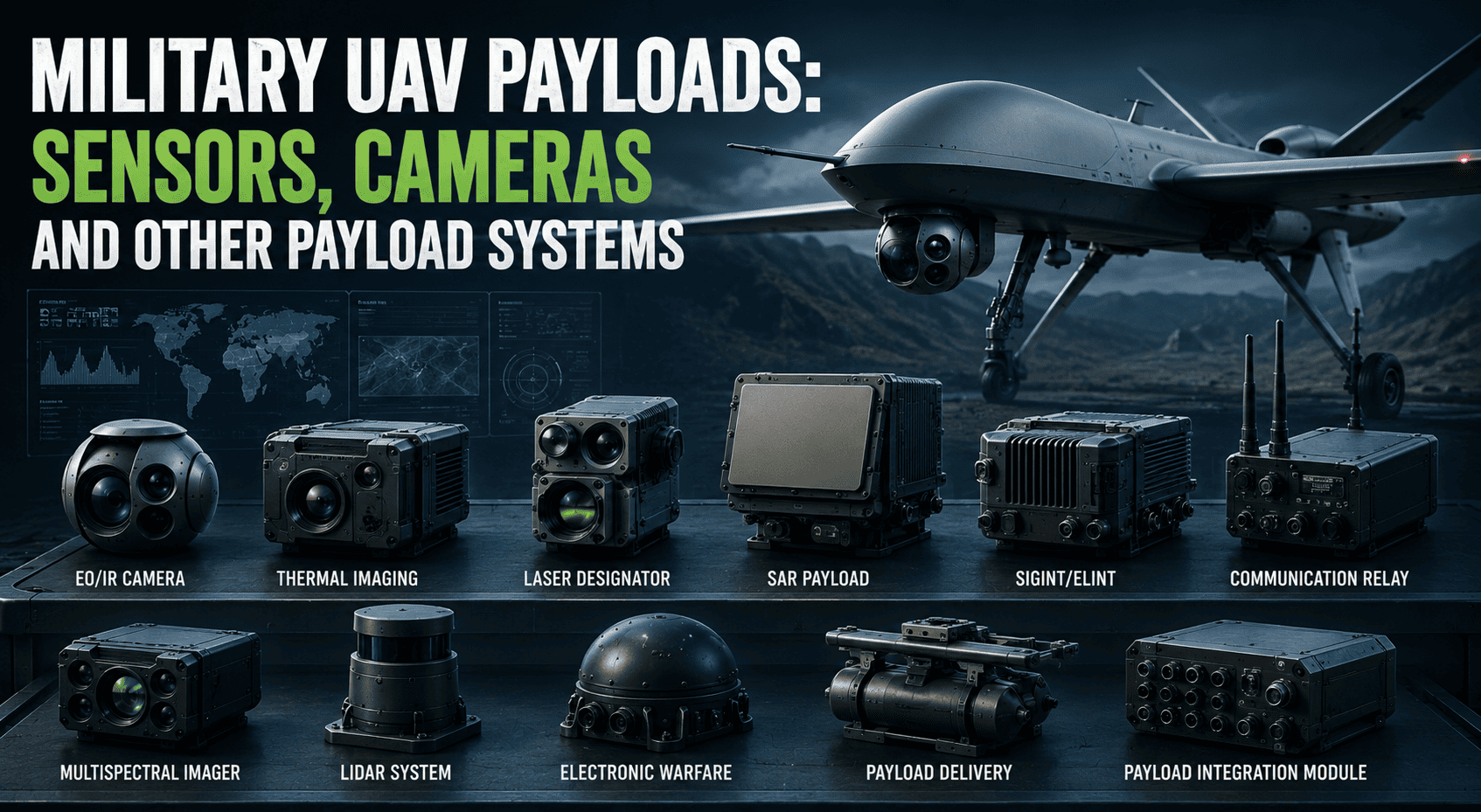
Modern defense operations increasingly depend on unmanned aerial systems for surveillance, reconnaissance, intelligence gathering, and situational awareness. A Military UAV can perform these missions effectively by carrying specialized payloads designed for specific operational requirements.
A UAV payload refers to the equipment carried by an aircraft to perform a particular mission. Depending on the platform, payloads can include high-resolution cameras, thermal sensors, radar systems, communication equipment, and other specialized technologies.
For a Military UAV drone, selecting the right payload is essential because the aircraft's capabilities depend heavily on the sensors and equipment it carries. This article explores the major types of Military UAV payloads and their role in modern defense.
A UAV payload is mission-specific equipment carried by an unmanned aircraft. Unlike the components responsible for flight and navigation, payloads are designed to collect information, support communication, monitor environments, or perform other mission functions.
Payload selection depends on factors such as UAV size, weight capacity, power availability, endurance, operating altitude, and mission objectives. A compact surveillance UAV may carry a camera and thermal sensor, while a larger platform can accommodate several advanced systems.
Different missions require different payload technologies. Modern UAVs can carry individual sensors or integrated systems combining several capabilities.
Electro-optical cameras are among the most common payloads used on military unmanned aircraft. They capture visible-light imagery and allow operators to observe terrain, infrastructure, vehicles, and other objects from the air.
High-resolution and stabilized cameras can provide detailed imagery during reconnaissance and surveillance missions. For Military surveillance drones, these systems are particularly valuable because they provide real-time visual information to ground operators.
Thermal imaging payloads detect infrared energy and identify differences in heat signatures. This allows UAVs to support observation during nighttime and reduced-visibility conditions.
Thermal sensors can complement conventional cameras by providing information that may not be visible through standard optical imaging. Combining thermal and electro-optical systems can therefore provide stronger day-and-night surveillance capabilities.
Radar payloads use radio waves to detect and monitor objects and terrain. Advanced radar systems can provide information about distance, movement, and location while supporting surveillance over large areas.
Some platforms use Synthetic Aperture Radar (SAR) to create detailed images of terrain. Radar can also operate in conditions where optical cameras may have limitations, making it an important payload technology for certain Military UAV missions.
LiDAR uses laser pulses to measure distances and generate detailed information about terrain and physical structures.
When integrated into a Military drone, LiDAR can support mapping, terrain analysis, infrastructure inspection, and three-dimensional environmental modeling. It is useful when accurate information about elevation and physical structures is required.
Some UAVs carry communication payloads designed to support or extend communication networks. These systems can act as airborne communication nodes and help transmit information between units operating across remote or challenging environments.
Communication payloads can improve connectivity between UAVs, ground stations, and other authorized platforms while supporting the exchange of mission information.
Signals intelligence, or SIGINT, payloads are designed to collect and analyze electromagnetic signals. These systems can support intelligence-gathering missions by monitoring relevant signals within an operational environment.
Advanced SIGINT systems can contribute to broader intelligence and situational-awareness capabilities when integrated with other UAV sensors and communication technologies.
Modern UAVs increasingly use integrated payload systems that combine multiple sensors in one platform. A multi-sensor payload may include electro-optical cameras, thermal imaging, infrared sensors, radar, and other mission-specific technologies.
Combining different sensors allows operators to obtain multiple types of information from a single UAV. This can improve situational awareness and allow the aircraft to perform effectively across different environmental conditions.
For Military surveillance drones, multi-sensor systems can be particularly valuable because surveillance missions may continue during changing weather and lighting conditions.
Choosing a suitable payload requires more than selecting the most advanced sensor. The payload must be compatible with the UAV's size, weight capacity, power supply, communication architecture, and mission requirements.
Important factors include:
A lightweight UAV may prioritize compact cameras and thermal sensors, while a larger aircraft can carry heavier radar or multi-sensor systems.
A Combat drone may use specialized payload configurations depending on its operational role. Alongside surveillance and reconnaissance sensors, combat-oriented platforms can incorporate mission-specific equipment.
Payload integration can affect an aircraft's endurance, balance, power consumption, and overall performance. Therefore, payload selection must be carefully matched with the intended mission and UAV design.
Military UAV payload technology continues to develop alongside advances in artificial intelligence, miniaturized sensors, imaging systems, and onboard data processing.
Future payloads are expected to become smaller, lighter, and more capable. AI-assisted image analysis may help process large volumes of sensor data and identify relevant objects or patterns more efficiently.
Sensor fusion is another important development, allowing optical, thermal, radar, and other data sources to be combined into a more comprehensive operational picture.
Modern defense missions require UAV platforms equipped with reliable sensors and mission-specific payload systems. Divyania offers advanced military UAV solutions designed for surveillance, reconnaissance, border monitoring, and threat-detection applications.
Its UAV platforms incorporate technologies such as AI-driven navigation, multi-sensor payloads, long-endurance capabilities, and advanced communication systems, supporting defense organizations that require dependable aerial surveillance and intelligence capabilities.
Payload systems are central to a Military UAV's mission capabilities. Cameras, thermal sensors, radar, LiDAR, communication systems, SIGINT equipment, and multi-sensor platforms allow UAVs to perform different defense and surveillance tasks.
The right payload depends on mission objectives, UAV capacity, operating conditions, endurance, and required situational awareness. As artificial intelligence and sensor technologies continue to advance, Military UAV payloads are expected to become increasingly compact, intelligent, and capable.
Reach Us