22
Sep
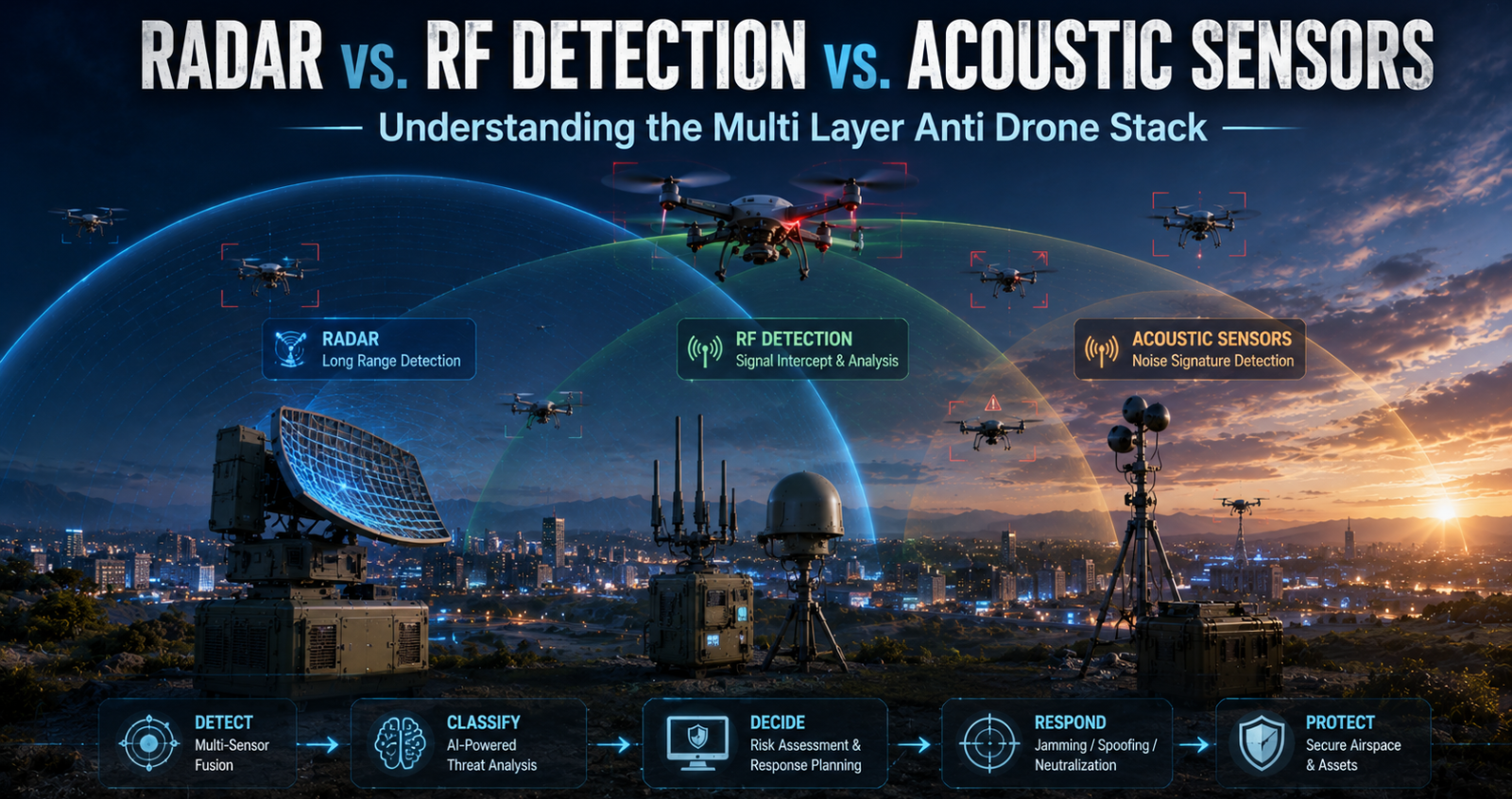
The proliferation of UAVs has created both opportunities and threats across defence and industrial domains. While UAVs enable surveillance, logistics, and tactical operations, they also pose risks when deployed maliciously. To counter these threats, layered detection systems have emerged combining radar, RF, and acoustic sensors into a unified anti drone system.
For governments, defence organisations, and private defence companies, understanding this multi-layer stack is critical. Divyania, as a global technology company, contributes to advancing dialogue and innovation in counter drone system architectures.
Radar remains the backbone of anti drone defense system deployments.
Divyania supports research into radar-enhanced anti drone technology for defence organisations worldwide.
RF detection systems intercept communication signals between UAVs and their operators.
RF detection is a critical layer in counter UAV system deployments, complementing radar capabilities.
Acoustic sensors detect UAVs by analysing sound signatures.
Acoustic detection adds resilience to anti drone solutions, especially in urban and industrial settings.
The most effective anti drone defense system integrates radar, RF, and acoustic sensors into a layered architecture:
This multi-layer approach ensures comprehensive coverage, reducing vulnerabilities across defence and civilian infrastructures. Divyania actively promotes such integrated architectures for global defence organisations.
Divyania contributes expertise to both defence and civilian applications, ensuring resilience across sectors.
Recent innovations in anti drone technology include:
Divyania collaborates with partners to advance these technologies globally.
Governments and research organisations are actively shaping anti-drone policy frameworks. Key institutions include:
Divyania aligns its strategic vision with such institutions to ensure compliance and innovation.
By 2030, multi-layer anti-drone stacks will be embedded across defence and civilian ecosystems. AI-enabled sensor fusion will provide autonomous detection and response, while portable systems will enhance tactical flexibility. Defence organisations and private companies that invest early will secure operational superiority.
Divyania continues to position itself as a trusted partner in this transformation, bridging anti drone solutions with global military innovation.
Q1: What is an anti-drone system?
An anti-drone system is a defence mechanism designed to detect, track, and neutralise hostile UAVs using radar, RF, and acoustic sensors.
Q2: How does radar detect UAVs?
Radar emits radio waves and detects reflections, effective for larger UAVs but challenged by small drones.
Q3: What role does RF detection play?
RF systems intercept communication signals between UAVs and operators, identifying both drone and operator locations.
Q4: How do acoustic sensors work?
Acoustic sensors capture UAV noise signatures, processed by AI algorithms to identify drones in cluttered environments.
Q5: Which organisations lead anti-drone research globally?
The U.S. Department of Defense, European Defence Agency, NATO, and NIST are key institutions advancing counter-UAV research.
Reach Us